Coriolis vs Electromagnetic Flowmeters: When to Use Which
Technical Guide / May 2026 / 10 min read / By Shengshi Engineering Team
Quick answer: Coriolis and electromagnetic flowmeters solve different problems. Coriolis meters measure mass flow directly and are ideal for high accuracy or density-related applications. Magnetic flowmeters are cost-effective for conductive liquids in larger pipe sizes.
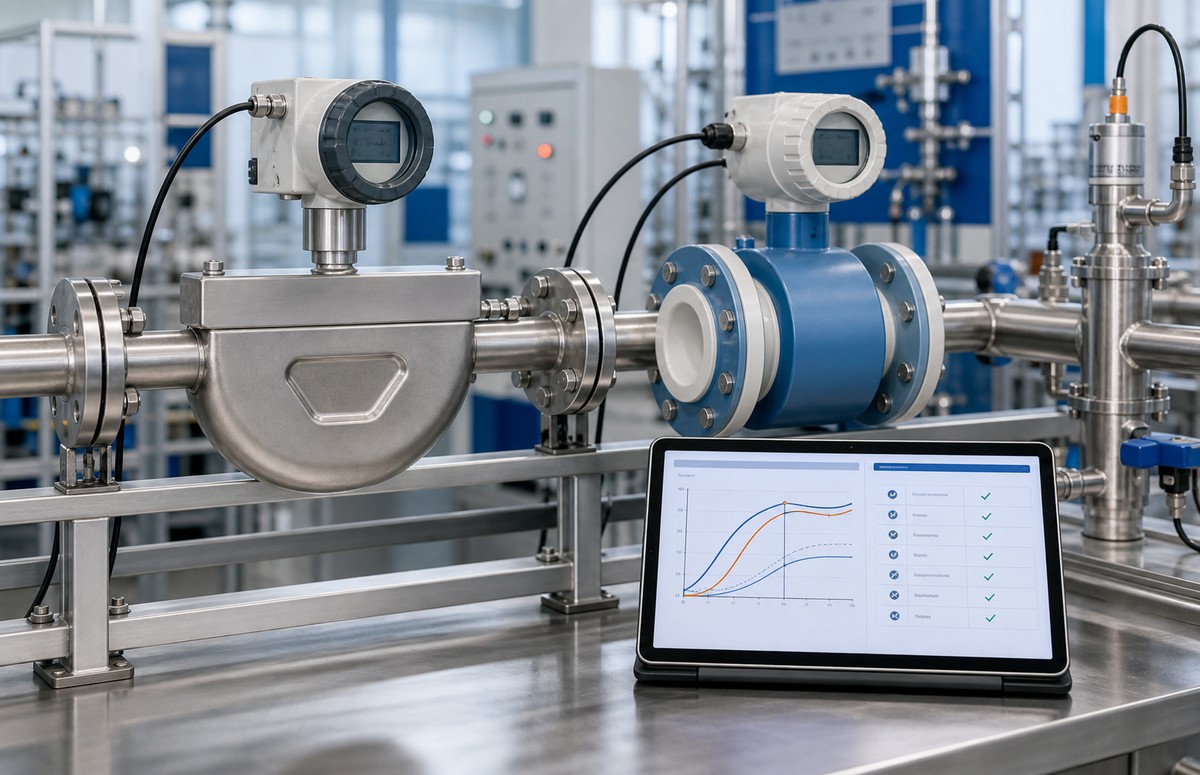
Use Coriolis When Accuracy Matters
Coriolis meters are preferred for dosing, custody transfer, concentration control and fluids where density or temperature compensation matters. They have no straight-run requirement but usually cost more, especially at larger line sizes.
Use Magnetic Flowmeters for Conductive Liquids
Magmeters work well for water, wastewater, acids, bases and slurries when the liquid is conductive. They have no moving parts, low pressure drop and attractive pricing for medium and large pipes.
Magmeter grounding: check the pipe and reference path
A conductive liquid alone does not complete the installation check. Protective earth addresses electrical safety; the process reference provides the measurement reference. Confirm both arrangements in the selected meter manual.
- Conductive, unlined pipe: verify that the specified bonding arrangement provides contact with the liquid.
- Plastic or internally lined pipe: check whether the sensor has a suitable reference electrode or needs grounding rings. Rings are not automatically required for every model.
- Ring selection: confirm chemical compatibility with the liquid and the manufacturer’s installation requirements.
For cathodically protected pipelines or electrolytic processes, obtain the manufacturer’s application-specific scheme before choosing the installation arrangement. Do not change protective-earth wiring to troubleshoot a flow reading. See Rosemount’s installation and grounding technical note and SIKA’s explanation of grounding rings.
Decision Table
| Question | Choose Coriolis | Choose Magmeter |
|---|---|---|
| Need mass flow? | Yes | No |
| Liquid conductivity? | Not required | Required |
| Large pipe size? | Often expensive | Usually economical |
| Need density? | Built in | External measurement needed |
Specification Tip
Always provide fluid name, viscosity, density, conductivity, temperature, pressure, line size, flow range and material requirements. Those details let us compare E+H, Siemens, Yokogawa, ABB and Emerson fairly.
Procurement tip: send the complete model code, nameplate photo or process datasheet. Shengshi engineers can verify the configuration before quoting so you avoid wrong-code purchases.
Need Help Choosing?
Send us your model codes, process conditions or photos. Our engineers will compare available options and reply with price, lead time and documentation requirements.
Get a Quote in 12 Hours
Send model codes or process data. We verify configuration, availability and lead time.