Solenoid Valve Selection: 2/2 vs 3/2, Direct vs Pilot Operated
Technical Guide / April 2026 / 7 min read / By Shengshi Engineering Team
Quick answer: A solenoid valve should be selected by function first, then by operating principle, body material, seal material, voltage and hazardous-area approval. Most ordering mistakes happen when the valve function or minimum differential pressure is not checked.
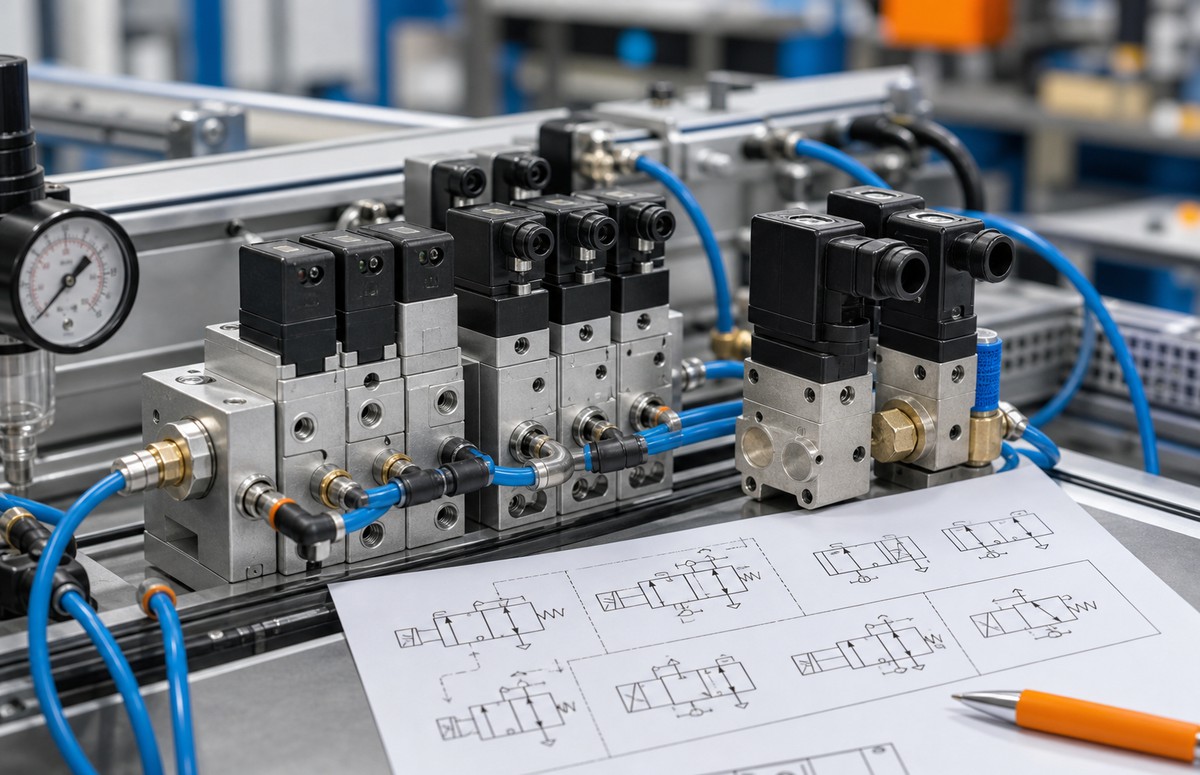
2/2 or 3/2 Function
A 2/2 valve has two ports and two positions, commonly used to open or close a fluid line. A 3/2 valve has three ports and two positions, commonly used to pilot pneumatic actuators or vent a control line.
Direct Acting vs Pilot Operated
Direct-acting valves move the seal directly with the solenoid, without relying on a pressure difference. Pilot-operated designs use fluid pressure to move the main seal, but some mechanically coupled designs can open at zero differential pressure. Check the exact design and operating limits, as illustrated in ASCO’s operating-principle guide.
Minimum differential pressure: Compare the pressure difference between inlet and outlet with the valve’s specified minimum. Opening at zero differential pressure does not guarantee full opening or the required flow. For example, Bürkert Type 6281 requires a minimum differential pressure to operate.
For Type 6213, the standard brass and stainless-steel tables in Bürkert’s EU data sheet specify 0.5 bar differential pressure for full opening (pages 18 and 20). The separate HP00 option is listed as DN13–DN20 and is described for zero-differential opening, including gas and vacuum applications. Do not apply the standard-version footnote to every 6213 configuration.
The standard tables also give a separate 0.5 bar minimum-pressure condition for DC gas or vacuum service and identify HP00 as an alternative. Confirm the article number, medium, coil and operating conditions with the manufacturer, then check the required flow at the actual pressure drop.
Material Checklist
Check body material, seal material, fluid compatibility, ambient temperature, process temperature, voltage, duty cycle, cable entry and explosion-proof requirements before quoting.
Common Brands
ASCO, Burkert, SMC, Festo, Norgren and Parker all offer strong ranges. Send the full code or a nameplate photo and we can identify an equivalent if the original model is obsolete.
Procurement tip: send the complete model code, nameplate photo or process datasheet. Shengshi engineers can verify the configuration before quoting so you avoid wrong-code purchases.
Need Help Choosing?
Send us your model codes, process conditions or photos. Our engineers will compare available options and reply with price, lead time and documentation requirements.
Get a Quote in 12 Hours
Send model codes or process data. We verify configuration, availability and lead time.